
Lion's Mane Mushroom (Hericium): What to Know Before You Take It
Lion's Mane is one of the most searched-for functional mushrooms in Switzerland. Here is what it really is, what we know about it today, and how to choose a product without falling for exaggerated promises.
In short
- Latin name: Hericium erinaceus. Also known as lion's mane mushroom, bearded tooth fungus or hedgehog mushroom.
- An edible mushroom eaten in Asia for a long time and now also cultivated in Europe.
- Its most studied compounds: hericenones (in the fruiting body) and erinacines (in the mycelium).
- Research remains mostly preclinical: in Switzerland, no health claim is authorised for Lion's Mane itself.
- What to check before buying: fruiting body or mycelium, extraction method, origin and amount per serving.
What is Lion's Mane mushroom?
Lion's Mane grows naturally on hardwood trees, often beech or oak. It is rare in the wild in Switzerland and protected in several European regions, which is why the Lion's Mane used in food and supplements is cultivated.
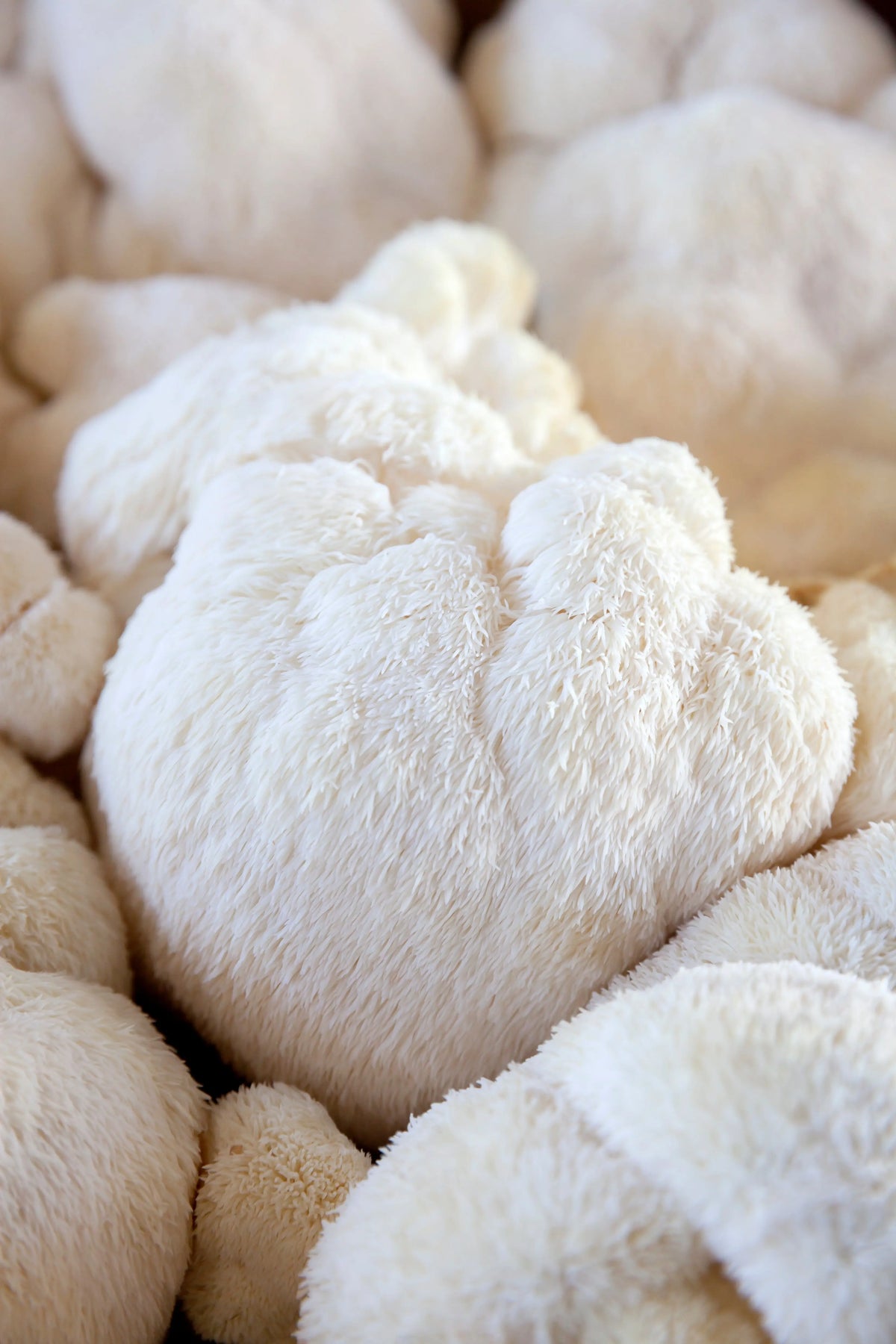
It looks like no other mushroom: a white mass covered in long, cascading spines that resemble a mane, hence the name. In the kitchen its texture is often compared to crab meat. As a food supplement it comes as an extract, a powder or a liquid.
What Lion's Mane contains
Like most functional mushrooms, it contains beta-glucans, fibres found in the cell walls of the mushroom. What sets it apart are two families of compounds specific to the species:
- Hericenones, found in the fruiting body (the visible part of the mushroom).
- Erinacines, found in the mycelium (the network of filaments that grows through the cultivation substrate).
This is why the part of the mushroom used changes the composition of a product. For more on these fibres, read Beta-glucans and food supplements: what the science says.
What does the research say?
Lion's Mane is the subject of many studies, particularly on the nervous system. However, most of this work is carried out in the laboratory or on animals. Human studies exist, but they are few and usually involve small groups.
As a result, in Switzerland as in the European Union, no health claim is authorised for Lion's Mane. A serious brand will therefore not promise you a better memory or deeper sleep from this mushroom alone. Be wary of those that do.
How to choose a Lion's Mane supplement
- Fruiting body or mycelium: the label should say which. Mycelium grown on grain can contain a lot of starch from its substrate.
- Extraction method: a simple powder of dried mushroom is not the same as an extract.
- Origin and cultivation: organic, grown in Europe, with an identified supplier.
- Dosage: the amount of Lion's Mane per serving should be stated, with no "proprietary blend".
- Format: liquid, capsule or powder. A liquid needs no capsule shell and is easy to take in a glass of water.
Our guide 7 criteria for choosing a quality food supplement in Switzerland covers each point in detail.
Liquid, capsule or powder: which format?
Lion's Mane is sold in three main formats. Powder can be stirred into drinks or food, but is often poorly standardised. Capsules are convenient on the go, but need a shell and sometimes excipients. Liquid extracts can be measured precisely and simply diluted in water. The right format for you mostly depends on your habits. We compare the pros and cons in Liquid supplements vs capsules: why the format matters.
How to take Lion's Mane
Lion's Mane is generally taken once a day, at the same time, so it becomes a ritual. Always follow the dosage on the packaging. Ask a healthcare professional for advice if you are pregnant, breastfeeding, taking medication or allergic to mushrooms.
Lion's Mane compared with other functional mushrooms
Lion's Mane is only one of many functional mushrooms. Reishi, Polyporus and Agaricus blazei each have their own origin, compounds and tradition. Our comparison Reishi, Lion's Mane, Polyporus, Agaricus: which functional mushroom suits you? gives an overview.
Lion's Mane at Hymne
Morphée, our evening formula, combines Lion's Mane with vitamins and minerals whose effects are recognised by Swiss regulations. For example, zinc contributes to the maintenance of normal skin, and vitamin B6 contributes to the reduction of tiredness and fatigue. The full composition is explained in Lion's Mane, biotin and zinc: what is really in Morphée?.
Morphée is a chocolate-flavoured liquid made in Switzerland, in a 450 ml amber glass bottle holding 30 servings.
Frequently asked questions
Is Lion's Mane the same as Hericium erinaceus?
Yes. Lion's Mane is the common English name for Hericium erinaceus. It is called Löwenmähne in German and hydne hérisson in French.
Can you eat Lion's Mane fresh?
Yes, it is an edible mushroom and some growers sell it fresh. A food supplement, on the other hand, provides a defined and consistent amount stated on the label.
Are the effects of Lion's Mane proven?
Research exists, but it is mostly preclinical. In Switzerland, no health claim is authorised for Lion's Mane. The recognised effects in a formula like Morphée come from its added vitamins and minerals.
When is the best time to take it?
There is no set time. What matters is regularity and following the dosage on the pack. Morphée is designed for the evening: 15 ml in a large glass of water.
Find more answers in our 10 most asked questions about functional mushrooms. To try Lion's Mane in liquid form: discover Morphée.
Read more

Four mushrooms, three formulas, one legitimate question: which one is right for you? At Hymne, each functional mushroom has been selected for its specific biochemical profile and its history in tra...
Fruiting bodies and mycelium differ in composition and cultivation. Learn how to spot grain starch, read beta-glucan figures and check a mushroom supplement label.