
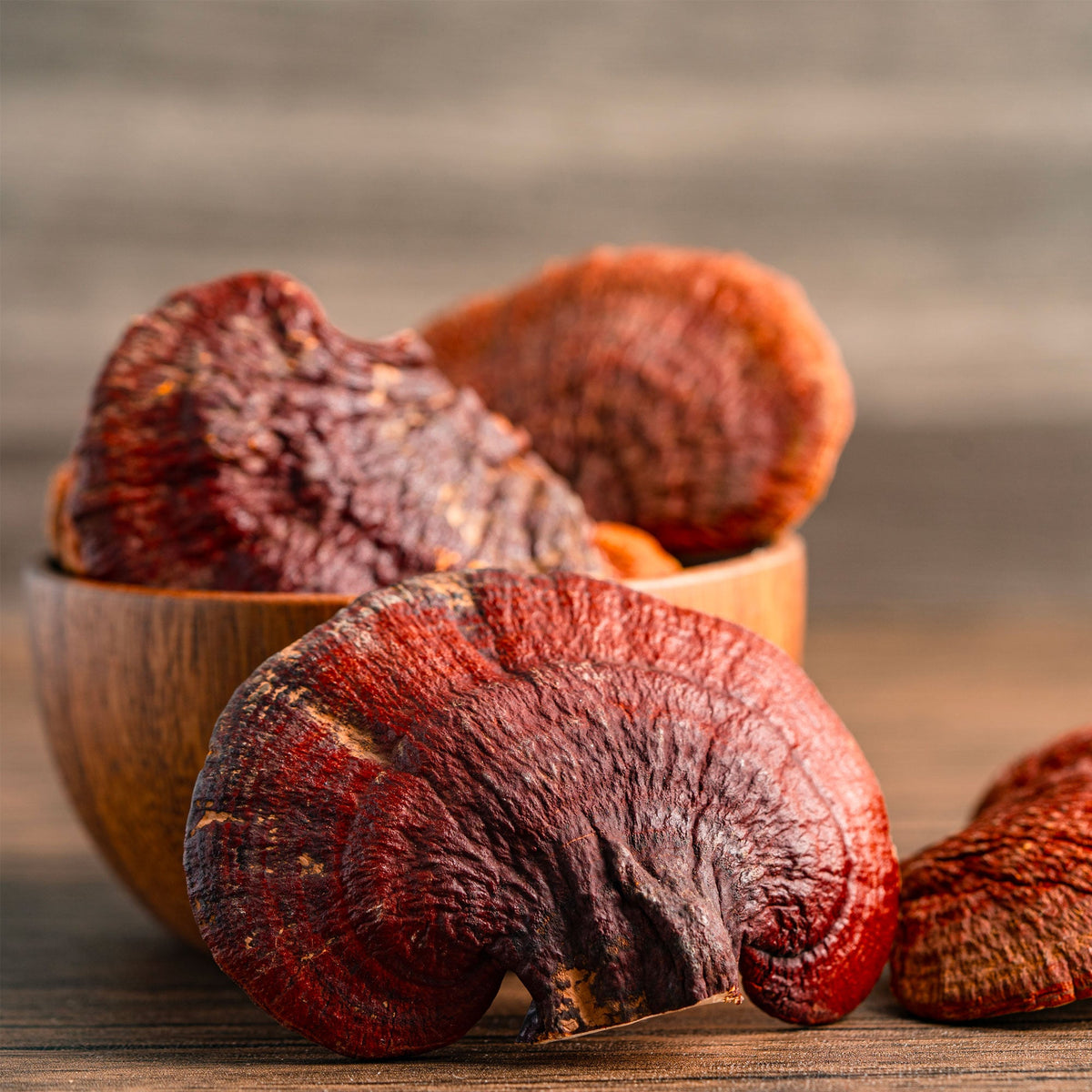
Reishi vs Chaga: How These Two Mushrooms Differ
Reishi and chaga are often mentioned together, sold on the same shelves and sometimes blended in the same products. Yet they have almost nothing in common: not their origin, appearance, composition or tradition. Here is how to tell them apart, factually.
In short
- Reishi (Ganoderma lucidum) is a glossy polypore that grows on hardwoods and is easy to cultivate.
- Chaga (Inonotus obliquus) forms a black mass on birch trees in cold regions and is mostly wild-harvested.
- Reishi is known for its bitter triterpenes, chaga for its pigments and birch-derived compounds such as betulin.
- Chaga contains a lot of oxalates, which is worth knowing before taking it regularly.
- Neither has an authorised health claim in Switzerland. Hymne offers reishi (in Hercule) but not chaga.
Two very different origins
Reishi grows on the stumps and trunks of hardwood trees in Asia, Europe and North America. It is rare in the wild but cultivates well on logs or substrate, so almost all reishi sold today is cultivated.
Chaga lives as a parasite, mainly on birch, in the cold forests of the northern hemisphere: Russia, Scandinavia, Finland, Canada and the northern United States. It grows slowly, over several years. The form harvested in nature is difficult to cultivate, so most chaga is wild-harvested, which raises questions of traceability and sustainability.
Appearance: lacquered cap vs black crust
Reishi looks like a mushroom: a kidney- or fan-shaped, reddish-brown cap with a shiny, varnished surface.
Chaga looks more like a lump of charcoal stuck to the trunk. Its surface is black and cracked, its inside orange and fibrous. This mass is not a fruiting body but a sclerotium, a compact mass of mycelium. Chaga's true fruiting body is rare and usually appears only once the tree has died.
Composition: reishi vs chaga
Both contain polysaccharides, including beta-glucans, like most mushrooms. Beyond that, their profiles differ:
- Reishi: rich in triterpenes, especially ganoderic acids, which make it bitter.
- Chaga: rich in dark, melanin-like pigments, in triterpenoids such as inotodiol, and in betulin and betulinic acid, compounds that come from birch bark.
A product's composition also depends on the part used and the extraction method. Our article Beta-glucans and food supplements: what the science says explains why.
Two distinct traditions
Reishi belongs to Chinese and Japanese tradition, where it has been depicted in art for centuries as a symbol of longevity.
Chaga comes from the folk traditions of Russia, Siberia and northern Europe, where it was steeped and drunk like tea. These traditions explain their popularity, but they are not proof of any effect.
What does the research say?
Both mushrooms are widely studied, mostly in the laboratory or on animals. Human studies remain limited, especially for chaga. In Switzerland, no health claim is authorised for either reishi or chaga.
Available formats
- Reishi: dried slices for decoction, powder, powdered extract, capsules, liquid extract.
- Chaga: chunks or chips for tea, powder, powdered extract, capsules.
Taste matters too: chaga tea is fairly mild and woody, while reishi is distinctly bitter, which is why it is often flavoured in liquid formulas. To compare formats, read Liquid supplements vs capsules: why the format matters.
What to watch out for
Chaga and oxalates. Chaga contains a high amount of oxalates. Cases of kidney problems associated with heavy, prolonged chaga consumption have been described in the medical literature. If you have a history of kidney stones or kidney disease, talk to a doctor before taking it.
For both mushrooms. Follow the stated dosage. Ask a healthcare professional if you are pregnant or breastfeeding, take medication, especially anticoagulants or treatments for blood sugar, have surgery planned, or are allergic to mushrooms.
Origin. For wild chaga, ask where it was harvested and how harvesting is regulated. For reishi, favour organic cultivation with an identified supplier.
Reishi vs chaga: comparison table
| Criterion | Reishi | Chaga |
|---|---|---|
| Latin name | Ganoderma lucidum | Inonotus obliquus |
| Other names | Lingzhi | Birch conk, clinker polypore |
| Where it grows | Various hardwoods, temperate and subtropical regions | Mainly on birch, cold regions of the northern hemisphere |
| Part used | Fruiting body, mycelium or spores | Sclerotium (the black mass), sometimes mycelium |
| Appearance | Reddish-brown, glossy, lacquered cap | Black, cracked mass, orange inside |
| Studied compounds | Triterpenes (ganoderic acids), polysaccharides | Polysaccharides, pigments, triterpenoids, betulin |
| Taste | Very bitter | Mild, woody, slightly earthy |
| Usual source | Mostly cultivated | Mostly wild-harvested |
| Watch out for | Medication, pregnancy, allergy | High oxalate content, medication |
| At Hymne | Yes, in Hercule | No |
So, reishi or chaga?
There is no "better" mushroom in absolute terms, and no authorised health claim can settle it. The choice mostly comes down to practical criteria: your preferred format, taste, traceability of origin and, for chaga, the oxalate question. If you are weighing up several functional mushrooms, our comparison Reishi, Lion's Mane, Polyporus, Agaricus: which functional mushroom suits you? will help.
What about Hymne?
Hymne does not offer chaga. Reishi is found in Hercule, a lemon-flavoured liquid formula that pairs it with Agaricus blazei and is currently almost sold out. The range also includes Morphée, with Lion's Mane, and Vénus, with Polyporus and vegan collagen, all made in Switzerland with organic mushrooms sourced in Europe.
Frequently asked questions
Is chaga really a mushroom?
Yes. Inonotus obliquus is a fungus. The part harvested, however, is not a cap but a sclerotium, a compact mass of mycelium that forms on birch.
Can you take reishi and chaga together?
Some products combine them. The available data do not allow a combination to be recommended. If you are considering it, follow each dosage, bear in mind chaga's oxalates and ask a healthcare professional if you take medication.
Which one tastes milder?
Chaga tea tastes fairly mild and woody. Reishi is clearly bitter because of its triterpenes.
Does Hymne sell chaga?
No. Hymne offers reishi, in Hercule, as well as Lion's Mane, Polyporus and Agaricus blazei.
To find the formula that fits your routine, explore the Hymne range.
Read more
Less famous than Reishi or Lion's Mane, Polyporus umbellatus has a long history in Asia. Its origin, compounds, research status and why it is rarely found in supplements.
A factual comparison of the four most searched functional mushrooms: Latin name, appearance, compounds studied, common forms and what Hymne does and does not offer.