
Polyporus umbellatus: the little-known functional mushroom
Most people have heard of Reishi or Lion's Mane. Polyporus umbellatus, on the other hand, remains a stranger, even among functional mushroom enthusiasts. Yet it has a long history in Asia and a remarkable biology. Here is what it is, what it contains, what research says and why it so rarely appears in food supplements.
In short
- Latin name: Polyporus umbellatus (synonym Grifola umbellata). English name: umbrella polypore. Chinese name: zhu ling.
- It grows from a sclerotium, a hard, dark underground storage organ that sends up clusters of small round caps.
- In China, the dried sclerotium has been used in traditional practice for centuries, usually combined with other ingredients.
- It contains polysaccharides, including beta-glucans, and sterols specific to the species. Research is mostly preclinical and no health claim is authorised.
- Because it is hard to cultivate, it is rare in supplements. At Hymne, you will find it in Vénus.
What is Polyporus umbellatus?
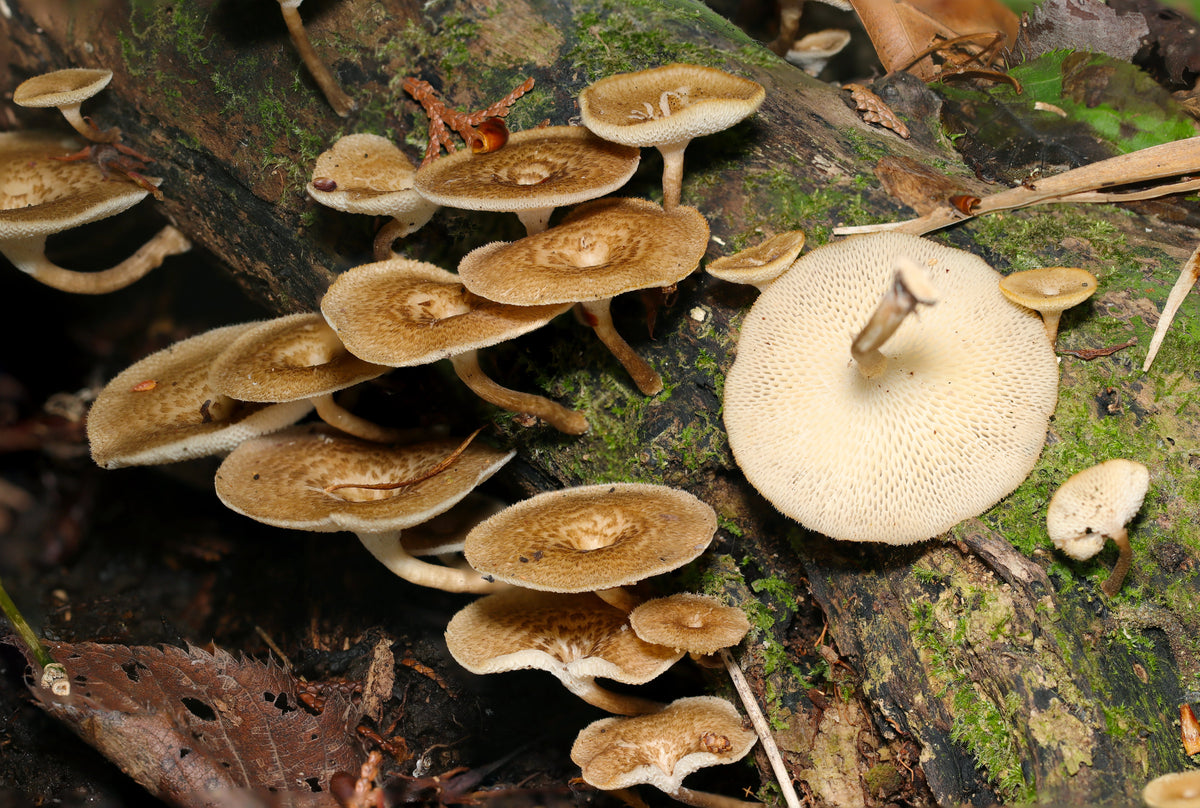
The umbrella polypore grows in broadleaf forests across Europe, Asia and North America, often at the foot of oaks and beeches, from summer to autumn. Above ground you see a cluster of many small, round, grey-brown caps, each on a branching stem rising from a shared base. The whole thing resembles an umbel, hence its name.
It is sometimes confused with maitake (Grifola frondosa), which also forms large clusters. The caps tell them apart: fan-shaped and overlapping in maitake, round and centrally attached in Polyporus.
The sclerotium, its hidden part
What makes it special lies underground. Polyporus forms a sclerotium: a hard mass, black outside and white inside, that acts as a reserve. New fruiting bodies emerge from it year after year. Its formation is linked to a relationship with other soil fungi, notably honey fungus (Armillaria), which partly explains why it is so difficult to cultivate.
A rare mushroom in the wild
In several European countries, the umbrella polypore is considered rare and appears on red lists. When young, it is edible and valued by mushroom lovers for its firm flesh. Because it is so rare, though, if you come across one in the forest, admire it and leave it where it is.
Traditional use in Asia
In China, the dried sclerotium is called zhu ling. It appears in classical texts of Chinese tradition and is combined with other ingredients in preparations, such as poria (Wolfiporia cocos), another sclerotium-forming fungus. It is traditionally sliced and used in decoctions.
A traditional use, however old, is not proof of an effect. In Switzerland, it also does not allow a food supplement to claim any health property.
What Polyporus umbellatus contains
Like other functional mushrooms, Polyporus contains polysaccharides, especially beta-glucans, fibres that make up the mushroom's cell walls. Our article on beta-glucans and what science says about them explains what is known about these compounds.
It also contains sterols: ergosterol, found in many mushrooms, and more specific compounds such as polyporusterones, identified in its sclerotium. These compounds are one reason researchers take an interest in the species. The exact composition depends on the part used, the origin and the preparation method.
What does research say?
Polyporus umbellatus is the subject of scientific studies, mainly in Asia. Most of this work is preclinical: carried out in the laboratory, on cells or in animals, often with purified polysaccharide extracts. Human data are scarce, often dated and concern very specific extracts that are hard to compare with a food supplement.
Put simply: the mushroom interests researchers, but no findings allow anyone to claim a health effect. That is why no health claim is authorised for it in Switzerland. A brand that attributes specific benefits to it is not following the rules.
Why Polyporus is so rare in supplements
- Demanding cultivation. Producing sclerotia takes time and particular conditions, linked to its association with other soil fungi.
- Low profile in the West. The market grew up around Reishi, Lion's Mane and cordyceps. Polyporus stayed in the shadows.
- Harder-to-source raw material, especially organic and of European origin.
If you are looking for a Polyporus product, check the Latin name, the part used, the origin and the amount per dose carefully. Our 7 criteria for choosing a food supplement in Switzerland will help you compare.
Polyporus at Hymne: the Vénus formula
At Hymne, Polyporus umbellatus is at the heart of Vénus. We combine it with vegan collagen derived from carrot and broccoli, reduced glutathione and zinc. Zinc contributes to the maintenance of normal skin. Like all our mushrooms, the Polyporus in Vénus is organic, sourced in Europe and not heat-treated.
Vénus is a liquid with a forest berry flavour: one 15 ml tablespoon a day in a large glass of water. To see how Polyporus compares with other species, read Reishi, Lion's Mane, Polyporus, Agaricus: which functional mushroom suits you?
Frequently asked questions
Is Polyporus umbellatus the same as maitake?
No. They are two different species, sometimes confused because both form clusters. Maitake is Grifola frondosa; the umbrella polypore is Polyporus umbellatus.
Can I pick it myself?
It is rare and protected in some countries. It is better to leave it in place and choose cultivated products.
How is it different from Reishi?
They are separate species with their own compounds. Reishi (Ganoderma lucidum) grows as a bracket on wood, while Polyporus develops from an underground sclerotium.
Who should seek advice before taking it?
Pregnant or breastfeeding women, people taking medication and anyone allergic to mushrooms should consult a health professional before taking any supplement.
Curious to try this little-known mushroom? Discover Vénus, with Polyporus and vegan collagen, CHF 69.00 for one month.
Read more
Timing, consistency, cooking vs supplements, forms and precautions: simple guidelines for taking lion's mane properly, with no promises of effects.
Reishi and chaga compared point by point: origin, appearance, composition, traditions, formats and precautions, with a summary table.